


There’s a version of the outdoor kitchen designed for somewhere else: nine months of warm weather, no salt air, and a climate that asks very little of the materials. Outdoor kitchens in New Hampshire are a different proposition. Freeze-thaw cycles, ocean air, shoulder-season rain, and a summer that arrives late and leaves on its own schedule all factor into what a space like this needs to be. The good news is that those constraints, designed around rather than ignored, produce spaces that are more considered and more lasting than anything assembled from a showroom floor.
A Space That Adds to the Home
An outdoor kitchen done well changes how the property gets used across an entire season. More evenings outside, more casual hosting, more of the gathering that tends to happen indoors by default migrating to a space that’s better suited for it.
What that looks like varies considerably by household. Some homeowners want a full working kitchen outdoors, with a professional-grade grill, dedicated prep counter, secondary sink, and refrigeration. Others want something more focused: a well-positioned grill station with enough counter space to work and enough storage to keep things organized. Neither is more correct. Ultimately, the right configuration is the one built around how a specific household cooks and hosts.
Material Selection Is a Structural Decision
On the Seacoast, material selection is an engineering question first and a style preference second.
Salt air, UV exposure, freeze-thaw cycles, and extended humidity are the reality of building outdoors here. NatureKast and Danver are the two partners KRB specifies for outdoor cabinetry, and both were engineered for conditions like these.
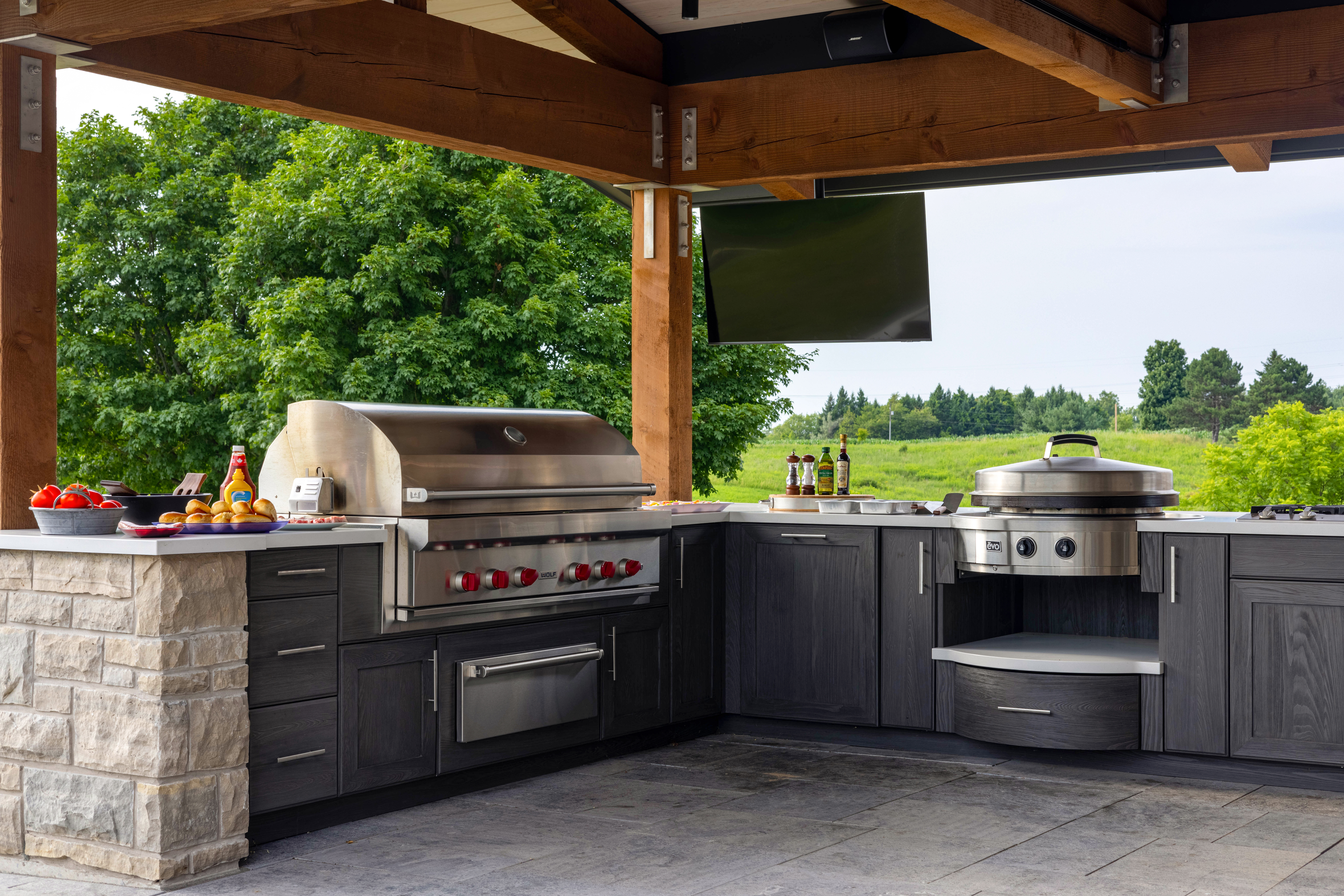
NatureKast builds its cabinet boxes from closed-cell PVC, joined with a weld-like PVC cement bond. Doors, drawer fronts, and mouldings are molded in high-density polyurethane resin cast from real oak, cypress, and teak originals, carrying the grain and texture of natural wood in a material that will not warp, crack, or rot outdoors. For homeowners drawn to a warmer, more residential aesthetic, it holds the look of wood in a material engineered for coastal exposure and New England winters.
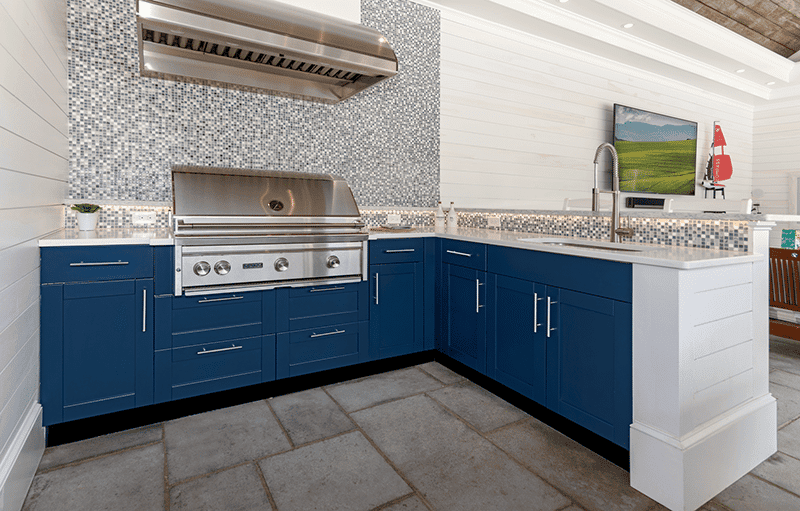
Danver, engineered and manufactured in Wallingford, Connecticut, builds in stainless steel, made to order in either 304 or marine grade 316L. The 316L is specified for salt air coastal environments precisely like the Seacoast. Five core door styles, a powder coat palette of roughly sixty finishes including realistic wood grains, double walled drawers riding full extension soft close undermount slides, and weather resistant rain gaskets on every door and drawer. Fabrication, finishing, powder coating, and assembly all happen in that Connecticut facility.
Still, the choice comes down to the project: the aesthetic direction, the existing architecture, and what the homeowner wants the space to feel like. Your designer will know which conversation to start with.
The Layout Question
An outdoor kitchen that doesn’t match how its owners cook is just expensive sculpture.
The layout conversation starts with workflow and sightlines. Where is the primary cooking happening? Does the cook face the gathering or a wall? Where do guests tend to land? Does the layout accommodate them without crowding the cooking zone? Is there a prep area separate from the grill zone, or does the household cook in a way that keeps everything centralized?
Counter depth, storage, and appliance placement all deserve the same attention as an interior renovation. A secondary sink for prep and cleanup. A beverage fridge positioned where guests can reach it without moving through the cooking zone. A warming drawer for households that do plated entertaining.
Together, these decisions build toward a space that functions well enough that people choose to use it, every time.
Designing for the Long Season
July and August are the obvious months. With planning, however, an outdoor kitchen on the Seacoast can carry from May through October.
A covered structure, whether a pergola, a sail shade, or a full roof, is the single biggest extension of the usable season: it handles spring rain, summer afternoon sun, and the cooler evenings of early fall. Overhead infrared heating panels, mounted to a structure above the cooking or seating zone, push the window further in both directions. Combined, these additions can open a space from late May through November.
That expanded season is also why material quality matters from the start. KRB chooses cabinetry, countertops, and finishes that perform across the full range of New England conditions. The space should look and function as well in year ten as it did at installation.
Where the Design Starts
Every outdoor kitchen project at KRB Kitchen + Bath begins the same place every interior project does: with a conversation about how the household lives. The layout, the materials, the appliance mix, the relationship between the outdoor space and the rooms it connects to, all of it follows from understanding the people who will use it.
If you’ve been thinking about adding an outdoor kitchen in New Hampshire and aren’t sure where to start, that conversation is the right first step. Get in touch to schedule your initial consultation with a KRB designer today.